Introducing Aeron Cluster Standby
With Aeron Cluster, multiple systems and nodes are connected and work together to provide high availability and fault tolerance. However, Aeron Cluster users often have to develop specific business logic to manage snapshots and synchronize data.
Aeron Cluster Standby provides elevated capabilities of resilience and redundancy to critical systems, ensuring high availability and fault tolerance at all times, hence minimizing the impact of failures or outages on daily operations:
- While one cluster serves as the primary/active cluster, handling all workloads, another cluster is in standby mode, typically in another availability zone, region or data center, ready to take over operations in case of a failure or planned downtime.
- By leveraging live cluster streaming and background snapshots, Aeron Cluster Standby can significantly reduce time to recovery and increase overall system availability.
- Like an active node, each standby cluster node processes every message, ensuring internal state consistency with the primary cluster as quickly as the logic and network allow. Data loss is limited to information that is in transit at the time of failure.
Aeron Cluster Standby enables significant flexibility, allowing configurations that balance bandwidth, costs and resilience. By routing all traffic through a single node, bandwidth costs can be minimized, while having all nodes receive the same data increases resilience. Configurations can be customized to achieve the optimal balance between these objectives.
Aeron Cluster Standby can also be used for manual node rebuilding in the event of a host failure and to offload functionality that could impact latency if running on critical path nodes.
Key Features
Technical Details
- Aeron Cluster is based upon a replicated state machine model.
- Active cluster nodes must work together to provide a consensus as to what is accepted into the log.
- Once agreed, nodes replicate the log and create their own live view of the application state.
- Standby nodes can “run behind” the active cluster without creating backpressure or creating latency issues on the critical path.
By removing the latency impact, Cluster Standby enables those features that would otherwise cause problems, e.g. snapshotting and offloading of slower operations.
Operational Considerations
- Users must be familiar with the network layout, bandwidth and link costs before deploying.
- Available as an Aeron Premium component.
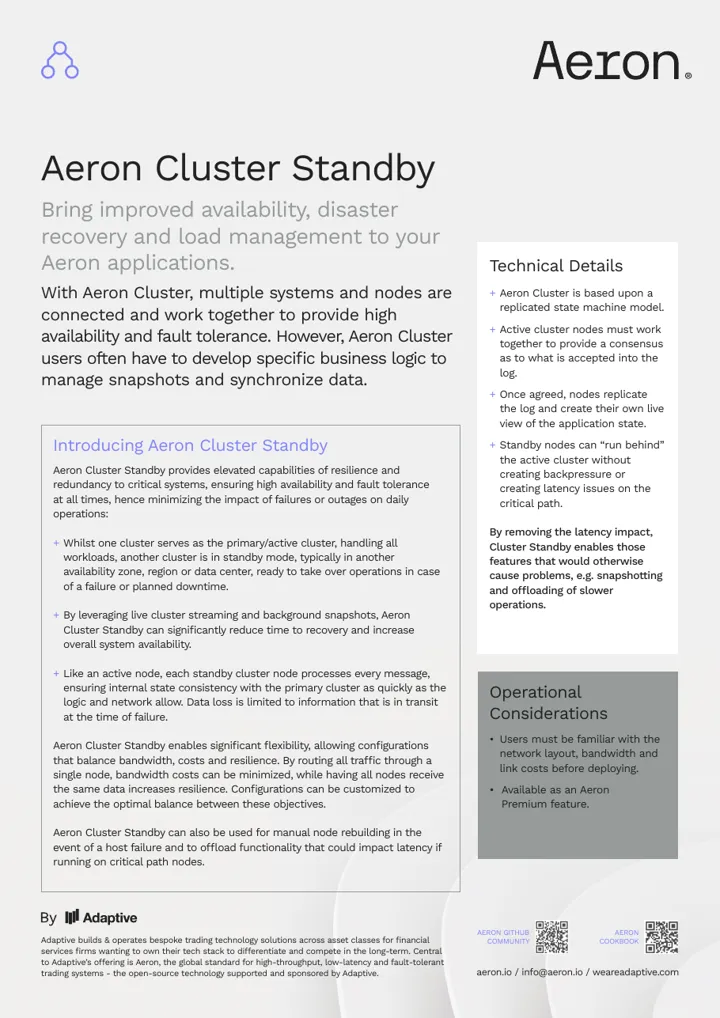
Aeron Cluster Standby Datasheet
For a detailed overview of Aeron Cluster Standby, download the datasheet:
- Introducing Aeron Cluster Standby
- Technical Details
- Operational Considerations
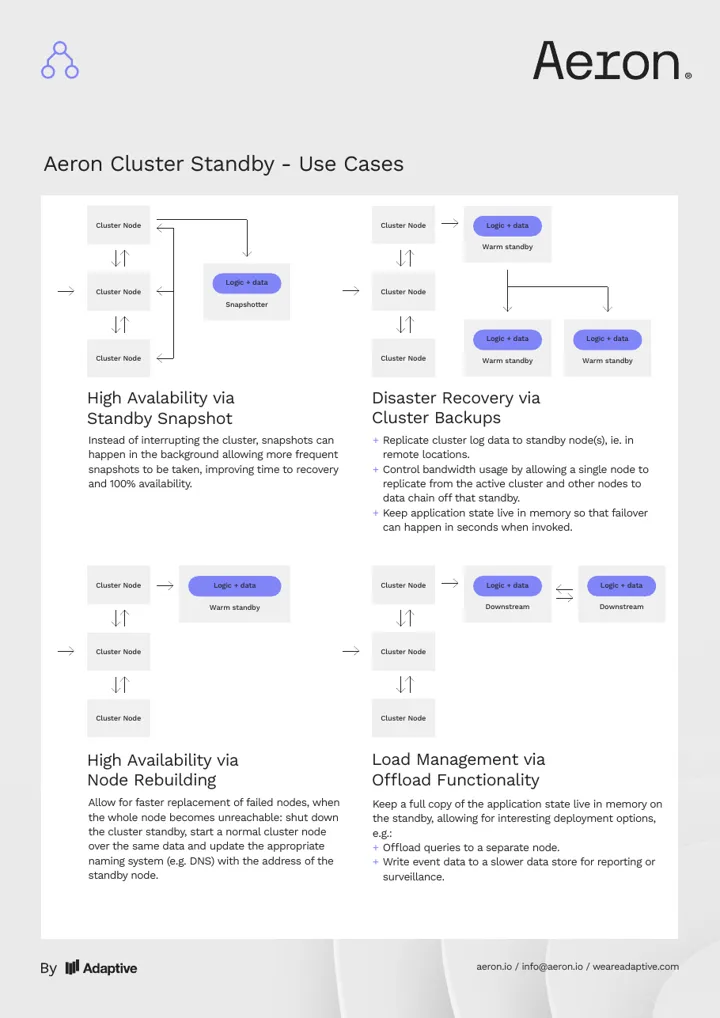
- High Availability via Standby Snapshot
- Disaster Recovery via Cluster Backups
- High Availability via Node Rebuilding
- Load Management via Offload Functionality
Aeron Cluster Standby Use Cases
Disaster Recovery via Cluster Backups
- Replicate cluster log data to standby node(s), i.e. in remote locations.
- Control bandwidth usage by allowing a single node to replicate from the active cluster and other nodes to data chain off that standby.
- Keep application state live in memory so that failover can happen in seconds when invoked.