

17th June 2026
Digital asset exchanges’ first major tech revamp calls for a strategic reset
By Ian Salmon, Head of Product Marketing, Adaptive
The emergence of digital asset exchanges upended the financial world, and their continued rise since the early 2010s has only entrenched them further within the global financial ecosystem. The technologies they introduced radically transformed operating models, trading and risk management practices as well as market participation – marking a significant shift away from conventional exchange frameworks.
Today, many digital asset exchanges are being confronted with the same structural challenges their traditional counterparts faced a decade ago, driven by a desire to scale, the move to 24/7, and increasingly stringent regulatory and compliance requirements, as well as soaring trading volumes, cross-asset class expansion, and rising institutional participation. The combination of these factors is often exposing limitations of the original tech infrastructures first movers built or acquired off-the-shelf during the early crypto years. Originally not designed to withstand such market conditions, these legacy systems can leave exchanges vulnerable to architectural constraints and resilience issues.
A market-defining choice
While tech stack modernisation is a natural next step for any capital markets firm following an initial development phase, many digital asset exchanges are experiencing its execution for the first time. The crypto industry is still maturing, and the market is evolving faster than the infrastructure that supports its functioning. It is paramount that firms innovate intelligently. The way in which digital asset exchanges choose to revamp their tech stacks will both determine their ability to compete over the long–term and contribute to defining future market structure.
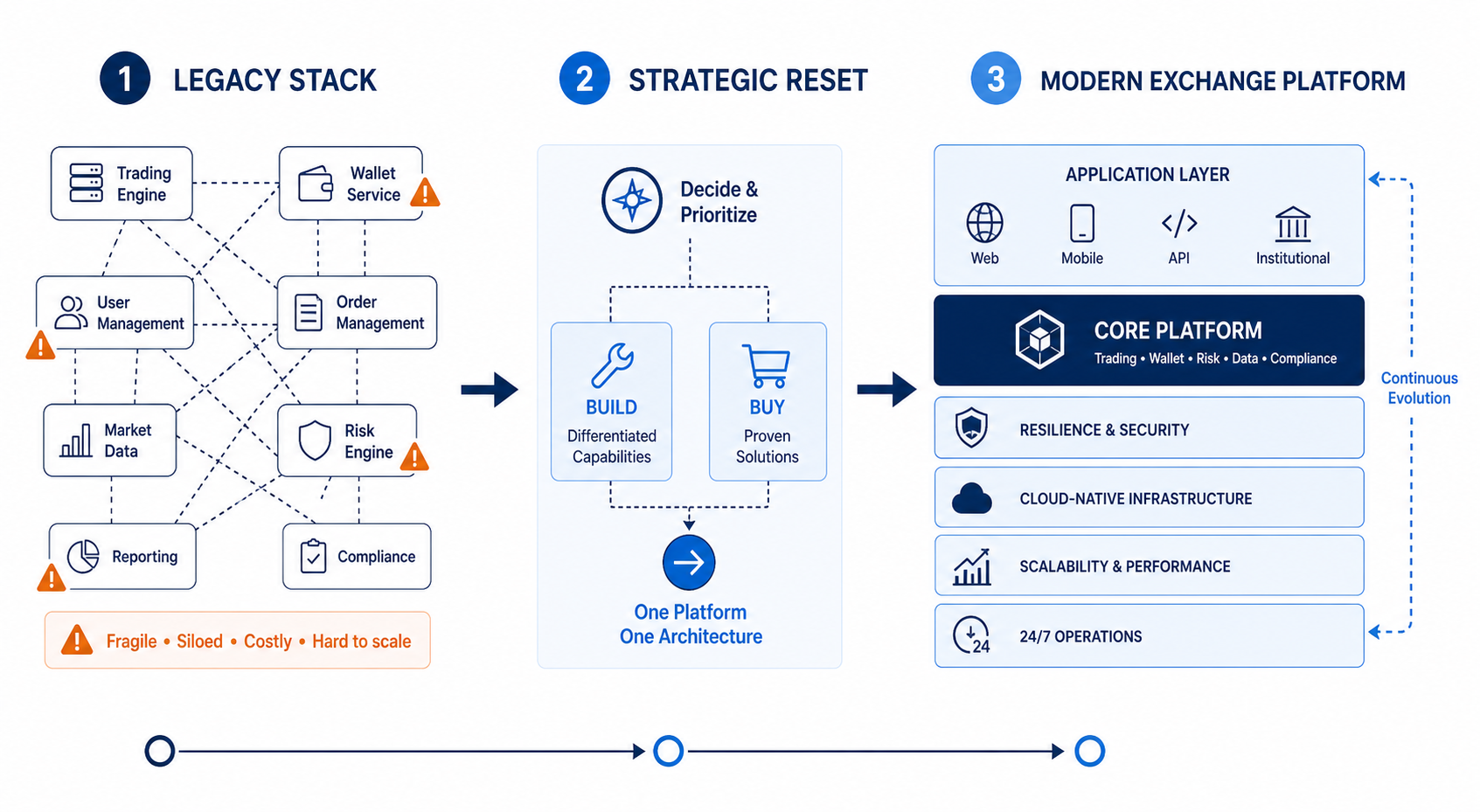
This need to modernise therefore presents an opportunity for a strategic reset – one where technology is considered a critical enabler of a firm’s strategy. To successfully future proof operations, exchanges must first ask themselves the right questions. Firstly, what capabilities are truly essential to remain competitive, and secondly, which parts of the tech stack supporting these capabilities should be bought vs built and owned.
Digital exchanges operating in today’s increasingly competitive landscape need to prioritise the ability to shift away from legacy patchwork systems toward a high-performing, resilient, modular, open-source, cloud-enabled platform capable of meeting the demands of an ‘always-on’ market. Equally as important is the ability to easily scale, upgrade, or replace individual tech components without having to shut down or reinvent the entire workflow – allowing exchanges to continue to respond quickly and adapt intelligently to new emerging needs.
When it comes to the buy vs build debate, the answer is both. Firms should adopt a hybrid model to enable true innovation, speed-to-market and ensure lasting differentiation. They should look to acquire the core, underlying infrastructure, on top of which any new functionality they build and own can be easily and quickly integrated. By owning the application layer, i.e. the business logic layer, firms can shape and customize their capabilities at their own pace and in line with their specific business needs.
Firms which only rely on vendor-sourced stacks, risk finding themselves in the same position in years to come: grappling with a lack of roadmap control, vendor lock-in and technology that is difficult to modernise, ultimately hindering their ability to compete with more nimble peers.
Trading technology that reflects strategic intent
Digital asset exchanges are increasingly treating their technology not as background infrastructure but as core intellectual property—owned, governed, and continuously enhanced with clear strategic intent.
The decisions they make today on how to modernise their tech stacks will shape their ability to scale, differentiate, and compete as the digital assets market matures and expectations rise. Exchanges that invest in a robust core while maintaining ownership of the features that define their unique value will be best placed to navigate the challenges that lie ahead.
Achieving this balance no longer requires multi‑year transformation efforts. Platforms exist today that enable digital asset exchanges to build and deploy resilient, high-performing, proprietary tech stacks within weeks, which seamlessly integrate with existing systems while allowing exchanges to retain control over long-term innovation.
In an ever‑changing market, the ability to innovate on one’s own terms will prove to be a lasting differentiator.
Learn how we can help you modernise your trading tech stack within weeks
 LinkedIn profile
FURTHER READING
 More about The new economics of equities trading infrastructure
Blog & Reports
The new economics of equities trading infrastructure
 More about Consistent by design: How sequencer architectures benefit exchange participants
Video & Podcast
Consistent by design: How sequencer architectures benefit exchange participants
 More about Aeron-powered trading technology: get to know the capital markets infrastructure stack that grows with you
Blog & Reports
Aeron-powered trading technology: get to know the capital markets infrastructure stack that grows with you
 More about Using React Native and Expo to power a leading UAE broker’s mobile trading app
Blog & Reports
Using React Native and Expo to power a leading UAE broker’s mobile trading app
 More about Podcast, by Harrington Starr: Exchange Tech is booming. Here is why…
Media & Awards
Podcast, by Harrington Starr: Exchange Tech is booming. Here is why…
 More about Adaptive is a proud partner of the WFE | World Federation of Exchanges
Blog & Reports
Adaptive is a proud partner of the WFE | World Federation of Exchanges
 More about Rothera selects Adaptive’s Aeron Exchange Accelerator to build its CFTC-regulated event contracts exchange and clearing platform
Blog & Reports
Rothera selects Adaptive’s Aeron Exchange Accelerator to build its CFTC-regulated event contracts exchange and clearing platform
 More about Building for the next big event: What prediction market operators need from exchange technology
Trading Resources
Building for the next big event: What prediction market operators need from exchange technology