
Blog & Reports

3rd March 2026
The second article will compare the distinct approaches that buy-side and sell-side firms are taking in revamping their tech stacks – exploring the adoption and attitudes towards new technology.
2025 has been a whirlwind year for capital markets. From geopolitical volatility and tariff-driven market shifts, to navigating the aftermath of the US’ transition to T+1 and growing regulatory divergence, not to mention the emergence of new cutting-edge technologies like agentic AI and their respective national governance frameworks.
In this fast-changing environment, capital markets firms have had to continually challenge and refine their existing technology strategies. Whilst the ability to quickly adapt and anticipate future trends has always been a strategic advantage, it has now become a deciding factor in firms’ capacity to sustain competitiveness.
Against this backdrop, delaying seizing control of their technology stacks and equipping teams with solutions tailored to their unique needs, leaves firms vulnerable to operational inefficiencies, compliance failures, higher costs, and faster-moving competitors.
Traditionally, capital markets firms have had to choose between two options when upgrading their tech stacks: buying off-the-shelf vendor solutions or building them from scratch. In recent years however, the ‘buy vs build’ debate has morphed into a more nuanced conversation, with the addition of a third, superior option: the hybrid model. The hybrid model, also called “buy AND build” advocates leveraging robust, third-party foundations for non-differentiating functions while developing proprietary layers on top to drive unique competitive advantages.
Adaptive partnered with MarketsMedia to conduct an industry survey to uncover key trends and evolving patterns in technology deployment and how those influence and are influenced by the ‘Buy and Build’ model. Speaking with 50 capital markets professionals* across the US, APAC, and EMEA reveals a clear shift toward hybrid development models as the preferred option, notably for front-office technology as well as more strategic approach to vendor relationships
Who calls the shots on trading tech?
Uncover the full data on how your peers are navigating the buy and build landscape.
44% of firms surveyed plan to take a bigger hybrid approach in the coming years, significantly outpacing the 26% who plan to lean primarily on in-house development or off-the-shelf solutions.
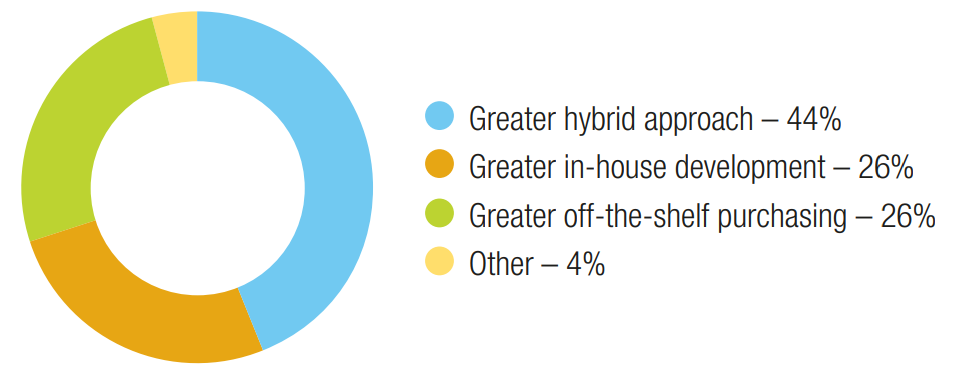
The shift illustrates how firms have come to understand the constraints of traditional vendor relationships, where control over the speed and direction of innovation is limited. Furthermore, the “patchwork” effect caused by layering multiple vendor systems—often from various independent providers—creates lasting technical debt that hinders a firm’s ability to differentiate over the long term.
While the move toward hybrid ‘buy and build’ models is a cross-industry trend, the motivations differ between the buy-side and sell-side. More than half of sell-side firms expect a greater increase in in-house development, with only 8% anticipating more off-the-shelf purchasing. This finding aligns with the sell-side’s general drive where control over a firm’s technology is paramount. By contrast the buy-side respondents expected more off-the-shelf purchasing than in house development, with a hybrid approach firmly leading the way at 58%.
When asked about supplier and in-house development, the survey also reveals a clear shift in vendor strategy among capital markets firms. The trend is moving away from reliance on a single, monolithic supplier and toward a more focused approach that combines a select number of expert vendors with deep domain expertise and an increased emphasis on in-house development. Only a minority of respondents expect to use a larger number of vendors (20%) and a tiny minority expect to focus on a single vendor (8%). Again, sell-side and buy-side specific differences persist which can be further explored in the full survey report (Access here)
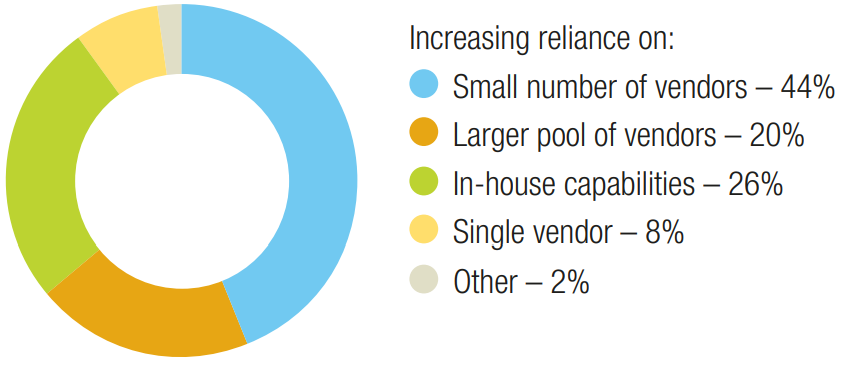
Today’s capital markets’ evolving landscape is pointing firms toward adopting the more pragmatic buy and build (‘hybrid’) model where non-differentiating foundational infrastructure components are purchased and supplemented with the building of fully owned proprietary technologies that drive alpha. In this scenario, the vendors’ role transitions from one-off suppliers to long-term, strategic partners, working closely with firms to define and advance their technology stack and roadmap. Firms do more than just solve an immediate problem; they gain the architectural flexibility to differentiate immediately post-build and sustain that edge over time through ongoing consultancy and technical guidance.
Firms that fail to rethink and modernize their tech strategy today, run the risk of their legacy off-the-shelf systems impeding their capacity to respond to and capitalise on tomorrow’s yet-to-be-known opportunities.
*Market Media, in partnership with Adaptive, conducted an industry survey of 50 capital markets professionals across the US, Asia Pacific (APAC) and Europe, Middle East and Africa (EMEA). The majority of respondents held roles spanning from senior managers across business and technology areas to portfolio managers, traders, analysts, quants, risk managers, compliance officers and salespeople. They represented a wide range of firms, including technology providers, market makers, investment firms and market infrastructure providers, and work across the fixed income, equity, listed derivatives, and FX markets.
FURTHER READING
Blog & Reports

Blog & Reports

Trading Resources

Blog & Reports