

12th March 2026
The road toward modular, open-source, cloud-native, AI-enabled systems in capital markets
By Paul Weiss, CTO at Adaptive
This is the second article in a two-part series exploring the modernization of capital markets technology stacks.
The first article, ‘The shift toward a pragmatic buy-and-build model’, examined how buy-side and sell-side firms are redefining their technology strategies by taking a more strategic approach to vendor relationships to reduce dependency.
In this second article we compare the distinct approaches that buy-side and sell-side firms are adopting to revamp their tech stacks, including the main factors influencing their strategy and how these are likely to evolve in the future.
The Modernization Mandate: Three forces reshaping capital markets tech
A confluence of emerging trends nearly a decade in the making is now converging, sending shockwaves across the capital markets industry and creating significant structural pressures on firms. Three shifts are redefining trading infrastructure, with firms’ competitiveness now heavily dependent on their technological prowess:
- The unprecedented speed of market structure change, fuelled by the adoption of advanced technologies. As market shifts become faster, firms are faced with the dual challenge of predicting and preparing for the unpredictable. The difficulty is compounded by the pace of change outstripping the speed at which legacy monolithic tech stacks can adapt. The fragmented structure resulting from years of layering multiple vendor solutions has created clunky, fragmented, near-inflexible tech stacks, hindering firms’ capacity to scale and respond quickly to change.
- The swath of unstructured data being generated daily following the emergence of real-time trading ecosystems. Firms’ ability to make sense of vast amounts of raw data near-instantly and accurately has become a significant competitive advantage – making modern, cloud‑enabled, componentized architectures essential.
- The fast-changing regulatory landscape, with requirements becoming more stringent and complex, compelling firms to rethink their technology strategies to ensure continued compliance and mitigate operational risk.
As these shifts converge, the need to modernize antiquated systems is indisputable. A recent survey conducted by MarketsMedia in partnership with Adaptive, involving 50 capital markets professionals across EMEA, NA, and Asia, shows that while firms are taking steps to modernize, clear and distinct patterns are emerging between the buy-side and sell-side.
Industry Report: The Modernisation Mandate
Who calls the shots on trading tech?
Uncover the full data on how your peers are navigating the buy and build landscape.
Next-generation tech: Capital market interest and adoption levels
According to the survey findings, buy- and sell-side firms alike are demonstrating strong interest in new technologies – open-source software, cloud computing, component-based technologies [Fig 15.], which are already being used by between 55% and 64% of firms. AI and ML are in use at 36% of firms with 40% running pilots.
A very small minority of firms (fewer than 13% and 18% respectively) have no plans to use componentized designs or cloud, while a higher percentage (28%) currently do not plan to leverage open source technology. The low number of firms with no future plans for these technologies indicates a widespread consensus on their importance.
In contrast to other innovative technologies, blockchain is at the bottom of the adoption curve, with 73% of respondents having no plans to adopt it at all. This finding suggests a significant lag in the practical application of blockchain within capital markets.
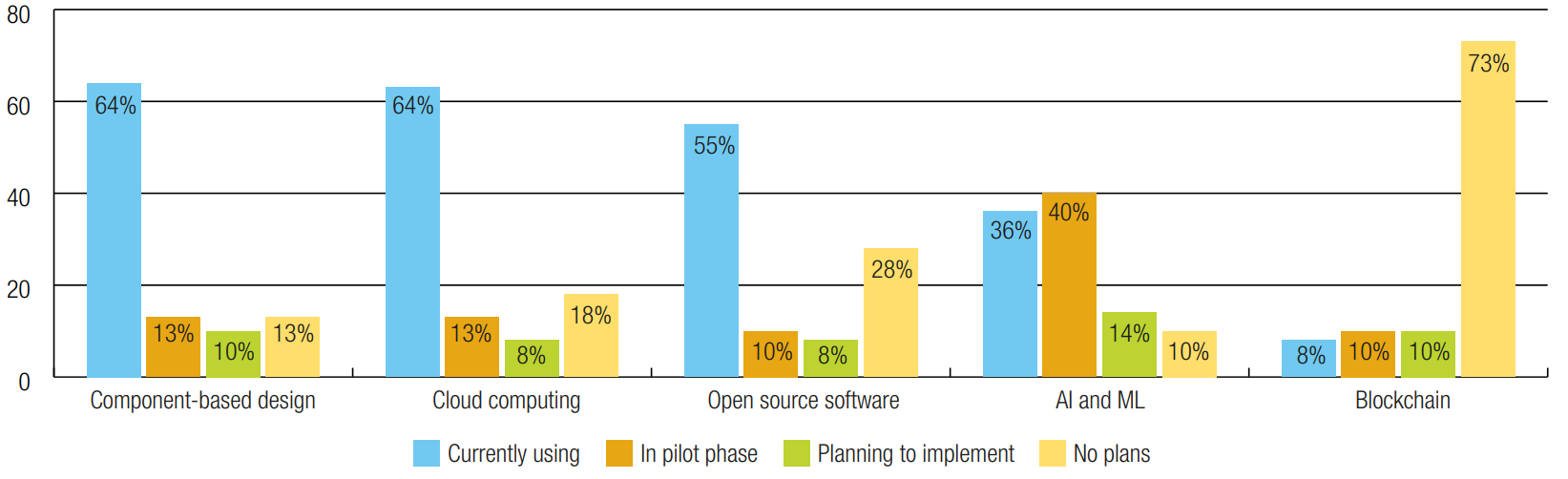
and where are you on the adoption curve?
Source: Markets Media’s Industry Report: The Modernisation Mandate
Strategic divergence: How Buy-Side and Sell-Side adoption timelines differ
Looking at the implementation of new technologies at buy-side and sell-side firms separately, timelines differ based on their unique business pressures. While both sectors are moving toward a more modern stack, the data reveals a “staggered” adoption curve driven by their specific roles in the market.
The survey identifies a major divergence in open source software adoption. The sell-side is leading this shift, with 70% of firms already actively using open source and another 20% in pilot phases.
For these firms, open source is a strategic tool for “platformization”—allowing them to standardize non-differentiating infrastructure and reduce the heavy operational expenditure of maintaining proprietary code for commoditized functions. By contrast, the buy-side remains more reserved, with 78% not having any active plans for adoption.
While the sell-side leads in open source, the buy-side is embracing cloud computing at a faster pace. Our findings show that 60% of buy-side firms are already leveraging the cloud, compared to 44% of the sell-side.
This acceleration can be seen as a direct response to the buy-side’s evolving business model. As asset managers shift toward data-heavy, alpha-generating strategies, they require the massive scalability and elastic compute power that only the cloud can provide. For them, the cloud is not just an infrastructure choice—it is a competitive necessity for processing the vast amounts of unstructured data required for modern trading.
Buy- and sell-side firms however align in their adoption of modular technology (67% each). These systems are made of ‘building blocks’ that can be easily upgraded or replaced individually, eliminating the historical need to reinvent entire tech stacks when modernising merely one component of the overall architecture. The popularity of modular technology across the industry reflects firms’ search for flexible, interoperable systems that can be easily designed and rapidly deployed in an ever-changing environment.
Similarly, buy- and sell-side firms show comparable adoption levels for AI/ML, with 40% and 36% respectively already using these technologies, while a further 50% and 36% are currently in pilot phases. Differing priorities can explain the slight discrepancy in overall usage level, with the sell side likely prioritising explainability, controls, and risk management whereas the buy side looks to enhance analytics and automation capabilities. Detailed results can be further explored in the full survey report (Access here).
Navigating the 2026 modernization mandate – Different paths leading to the same destination
Regardless of buy- and sell-side firms taking varied approaches to modernising their infrastructure, the industry is clearly, and irreversibly, shifting away from legacy patchwork systems toward modular, open-source, cloud-enabled, AI-enabled tech stacks.
With flexibility, scalability, and adaptability firmly cemented as decisive factors for long-term differentiation, firms must take control of their tech roadmap to ensure sustained competitiveness.
*Market Media, in partnership with Adaptive, conducted an industry survey of 50 capital markets professionals across the US, Asia Pacific (APAC) and Europe, Middle East and Africa (EMEA). The majority of respondents held roles spanning from senior managers across business and technology areas to portfolio managers, traders, analysts, quants, risk managers, compliance officers and salespeople. They represented a wide range of firms, including technology providers, market makers, investment firms and market infrastructure providers, and work across the fixed income, equity, listed derivatives, and FX markets.
 LinkedIn profile
FURTHER READING
 More about The shift toward a pragmatic buy and build model
Blog & Reports
The shift toward a pragmatic buy and build model
 More about Industry Research: Tech Deployment Patterns in Capital Markets
Blog & Reports
Industry Research: Tech Deployment Patterns in Capital Markets
 More about The capital markets crystal ball: Trends to watch in 2026
Trading Resources
The capital markets crystal ball: Trends to watch in 2026
 More about From principles to practice: operating sequenced distributed systems in capital markets
Blog & Reports
From principles to practice: operating sequenced distributed systems in capital markets